
 Available in GB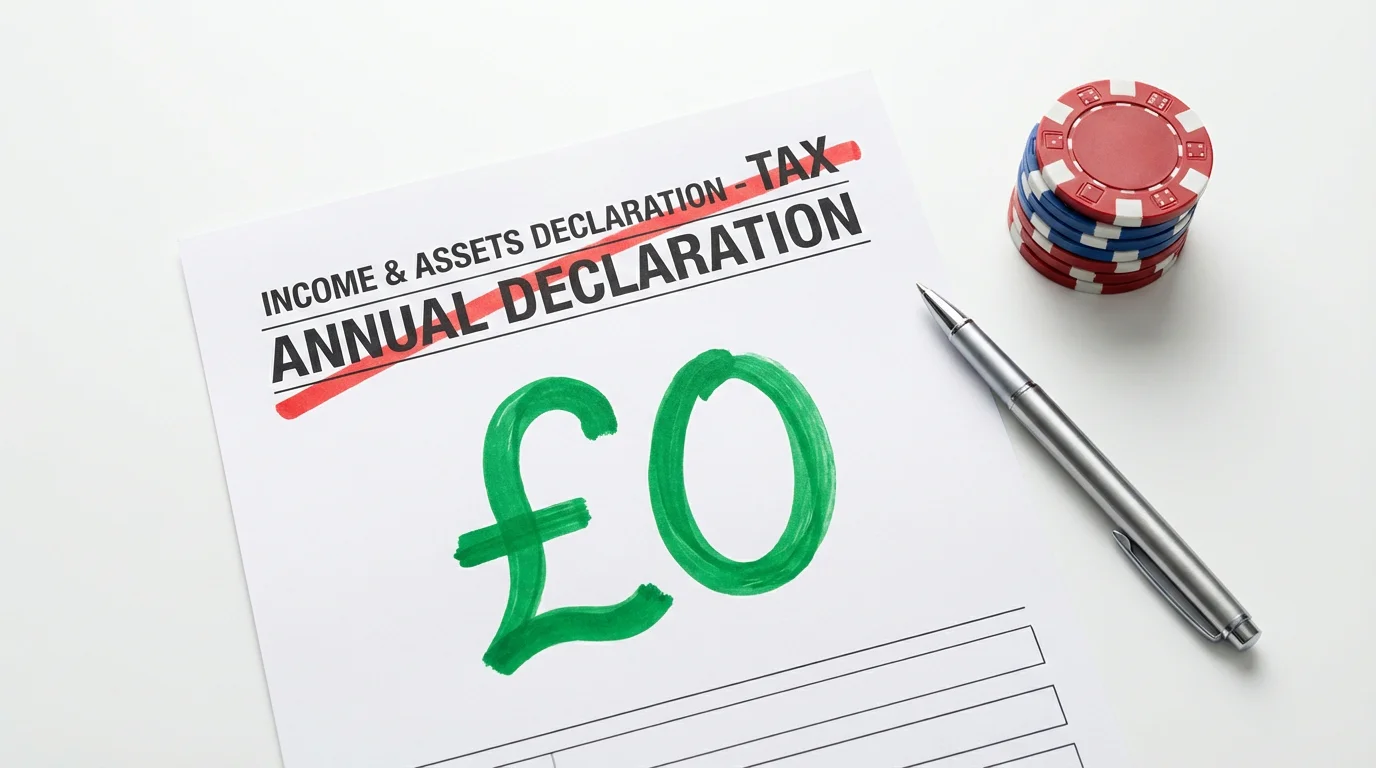
The Question Every Winner Asks
You’ve cleared the wagering requirement on a no deposit bonus, withdrawn £50, and the money is sitting in your bank account. Do you owe tax on it? The question surfaces every time a UK player wins anything meaningful from a casino, and it’s one of the few areas in gambling where the answer is genuinely good news: for the vast majority of UK players, casino winnings are completely tax-free.
This applies to all forms of gambling — casino games, sports betting, lottery, bingo, poker — and it applies regardless of the amount. Whether you withdraw £20 from a no deposit bonus or £20,000 from a progressive jackpot, HMRC does not treat it as taxable income for recreational gamblers. You don’t need to declare it on your tax return, you don’t need to keep records for tax purposes, and you don’t owe a penny of it to the government.
The reason this is the case, how the system works, and where the edges get blurry — particularly for anyone whose gambling activity starts to look professional — is worth understanding clearly. The rules are straightforward for most people, but the assumptions behind them matter if your circumstances change.
Recommended online casinos
- SpinFormulaBonus: 550% Up To £15,000 + 550 FS · Payout speed: 1-3 business days
- NightWinBonus: £900 + 400 free spins · Payout speed: 1-3 business days
- WinBeastBonus: €5000 + 500 FS + €650 Freebet · Payout speed: 1-3 business days
- BritsinoBonus: Welcome Package – Get your £2,200 + 2,000 FS · Payout speed: 1-3 business days
- EvoSpinBonus: 125% up to €2500 + 125 Free Spins · Payout speed: 1-3 business days
- DieselwinBonus: Welcome Pack 250% up to £4000 + 200 FS · Payout speed: 1-3 business days
- ChanzeBonus: Slots Welcome Bonus #1 200% up to €500 · Payout speed: 1-3 business days
Recreational Players — Why Your Winnings Are Tax-Free
The UK tax system does not classify gambling winnings as income for recreational players. This has been the position for decades, and it rests on a simple principle: gambling is not a trade, profession, or vocation for the typical player. It’s a leisure activity where outcomes are determined by chance, and the winnings from it are treated as a windfall rather than earned income.
This exemption is codified in HMRC’s guidance and applies equally to all forms of legal gambling. It doesn’t matter whether you won the money from a slot, a roulette table, a football bet, or a no deposit casino bonus. If you’re a recreational gambler — meaning you gamble for entertainment and not as a primary or secondary source of income — your winnings are not subject to income tax, capital gains tax, or any other form of taxation.
There’s no threshold or ceiling. A £5 withdrawal from a no deposit bonus and a £500,000 lottery jackpot receive the same tax treatment: zero. You don’t need to declare gambling winnings on your self-assessment tax return, and HMRC does not require you to maintain records of your wins and losses for tax purposes. The exemption is automatic and unconditional for recreational players.
Correspondingly, gambling losses are not tax-deductible. Since winnings aren’t taxed, losses can’t offset other income. This symmetry is important: the tax system treats gambling as a financially neutral activity from the player’s perspective. What goes in and what comes out are both invisible to HMRC, provided you’re gambling recreationally. The system works cleanly because the tax burden has been shifted entirely to the other side of the transaction — the operators.
Professional Gamblers — Where It Gets Complicated
The tax-free status of gambling winnings applies to recreational players. For individuals whose gambling activity constitutes a trade — a profession or business rather than a hobby — the position is less clear-cut and depends on the specific circumstances. This is a narrow category, and most casino bonus players will never fall into it, but the distinction is worth understanding.
HMRC’s test for whether gambling constitutes a trade considers factors such as the degree of organisation, the frequency and regularity of activity, whether the individual applies systematic methods, and whether the activity is their primary source of income. A recreational player who claims no deposit bonuses at weekends is not trading. A professional poker player who plays daily, tracks performance metrics, employs bankroll management strategies, and derives their living from gambling proceeds is closer to the boundary.
The leading case law on this point — specifically the Hakki v Secretary of State for Work and Pensions and Graham v Green precedents — has generally held that gambling, even when conducted with skill and regularity, is not a trade because the outcomes are inherently uncertain and do not constitute the provision of goods or services. Courts have been reluctant to classify gambling as a taxable trade, and HMRC has historically followed this position. The practical result is that even professional-level gamblers in the UK have generally not been required to pay tax on their winnings.
However, the area is not entirely settled, and circumstances vary. If you derive a substantial and regular income from gambling and have no other employment, it’s possible — however unlikely — that HMRC could scrutinise your position. The standard advice from accountants and tax professionals is that gambling winnings remain non-taxable for the overwhelming majority of UK residents, but anyone in an unusual situation should seek professional tax advice rather than relying on general guidance.
How Operators Pay Tax Instead of You
The reason UK players don’t pay tax on gambling winnings is that the tax burden sits with the operators instead. Since 2014, the UK has operated a point-of-consumption tax regime under which gambling operators are taxed on the gross gambling yield generated from UK customers. For online casino games, Remote Gaming Duty applies at a rate of 40% from April 2026 (up from 21%), following changes announced in the Autumn Budget 2025. This revenue-based tax ensures that HMRC collects gambling-related taxes from operators regardless of where they’re headquartered.
Gross gambling yield is, in simplified terms, the total amount staked by players minus the total amount paid out in winnings. It’s the operator’s revenue — the house edge realised across all customers. A casino that takes £10 million in deposits and pays out £9.5 million in winnings has a gross gambling yield of £500,000 and pays tax on that figure.
This structure is why the player’s winnings are untaxed. The government has chosen to collect gambling taxation at the operator level rather than the player level, which is administratively simpler and generates more predictable revenue. Taxing millions of individual players on variable and often modest winnings would be costly to administer and difficult to enforce. Taxing a few hundred licensed operators on their reported revenue is straightforward and efficient.
The operator tax has an indirect effect on players through the economics of bonus offers. The tax increases the cost of doing business for casinos, which means promotional budgets — including the funds allocated to no deposit bonuses — are influenced by the tax rate. Higher operator taxes don’t directly reduce your bonus, but they shape the commercial environment in which bonuses are designed and funded. The bonuses you see in 2026 are structured to be profitable for operators who are already paying a significant percentage of their UK revenue to HMRC.
Keep Your Winnings — the Taxman Isn’t Coming
For the typical UK casino player — someone who gambles recreationally, claims the occasional bonus, and withdraws modest winnings — the tax position is unambiguous. Your winnings are not taxable. You don’t need to declare them. You don’t need to set aside a portion for HMRC. The £50 you withdraw from a no deposit bonus is £50 in your pocket, full stop.
This is one of the genuinely player-friendly aspects of the UK gambling framework. The point-of-consumption tax on operators funds the regulatory system, contributes to public revenue, and removes any tax obligation from the player. It’s a clean arrangement that benefits recreational gamblers directly.
The only caveat — and it’s a narrow one — applies to individuals whose gambling activity is so systematic, frequent, and income-generating that it could theoretically be characterised as a trade. For the overwhelming majority of players, this doesn’t apply. If you’re unsure whether your situation is unusual enough to warrant professional advice, the question alone suggests the answer is probably no. But if in doubt, a conversation with a tax professional costs less than the uncertainty is worth.